
Fibre charts the way
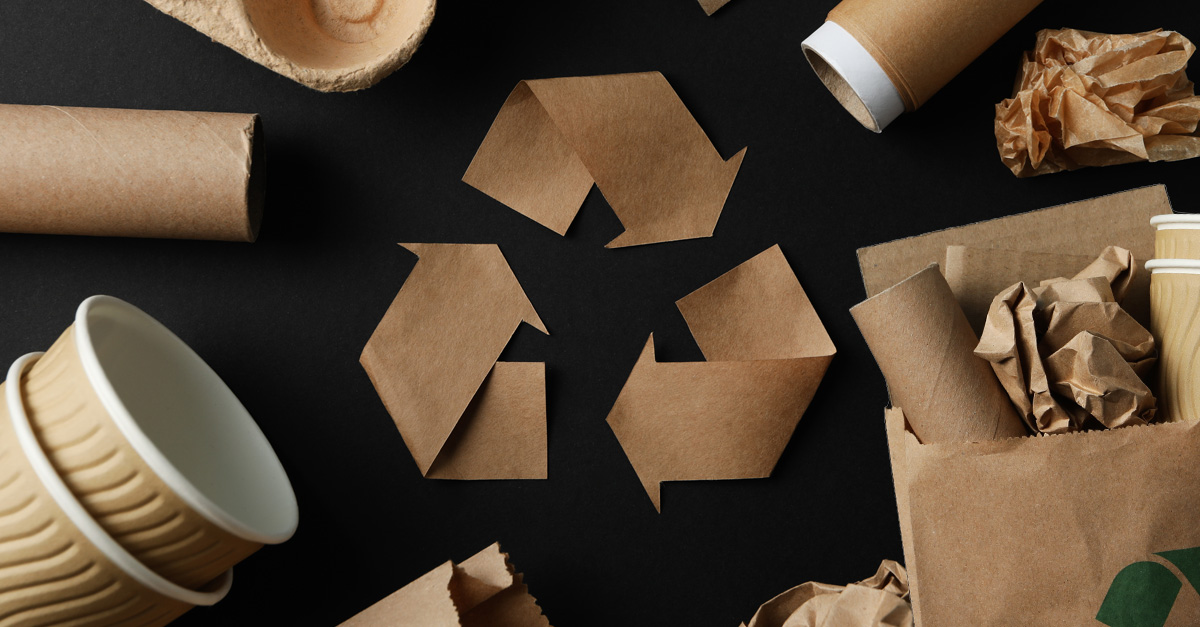
When it comes to circularity, paper is still king. Accelerating fibre circularity would come with significant carbon emission savings.
Most products and goods need to be protected during their journey from the manufacturer all the way to the end user. Without this vital packaging, the product would risk being wasted, and food and products that are never used, add to our growing heap of wasted resources, ultimately leading to more global carbon emissions.
Fibre-based packaging has for long been a go to option for a lot of goods. Think of all the electronics and clothes items you buy, either in store or online, or industrial applications that need to be protected to ensure quality.
When it comes to circularity, paper recycling has been a success story. For decades, fibre has been recycled and repulped to be used multiple times. Still today, the paper recycling stream is by far the most developed of all recycling streams. In Europe, fibre-based packaging has the highest recycling rate with 81,6% of all fibre being recycled. The corresponding figure for plastics, glass and metal is 38%, 75 & and 76 % respectively.
Paper recycling has been such a success story largely because a lot of products can be made from recycled fibre materials. Think of fine writing and printing papers, newspapers, paper towels, napkins, facial and toilet tissues, corrugated boxes and even packaging for food items such as egg cartons and cereal packages.
Another benefit is that paper can be recycled and reused multiple times. But it does not come without some wear and tear. Each time the recovered paper is pulped and reformatted into a new product, the paper fibres grow shorter and eventually the paper fibres will be too short to provide the needed strength. That is where virgin fibre comes into the picture: paper mills will use a mix of virgin and recycled paper materials to produce the pulp. Due to this, recovered paper is usually recycled into a paper grade equal or lower than the grade of the original paper.
As the world is charting a route away from plastics, fibre-based packaging has cemented its position as a suitable material for a wide array of applications, also in the food industry.
Paper and board are successfully used for everything from beverage cartons and frozen food to snack pouches. But most food products require a barrier to make sure that the food content stays intact. Spoiled food leads to more food waste with corresponding increase in carbon emissions, making shelf life and food safety a top priority. Even though this barrier is typically made from plastics, the good news is that this thin plastics barrier will usually not compromise the recyclability of the fibre packaging. There are several existing and emerging technologies to get a recyclable polymer barrier, such co-extrusion coating where the plastic barrier layer is made very thin, or through dispersion coating where you apply a wet coating that forms into a thin recyclable barrier layer.
Fibre for the growing on the go market
Our busy lifestyles have sent the market for take away food and food on the go on a fast growth trajectory, and this has given rise to a lot of packaging.
As take away food is typically consumed almost directly after purchase, fibre-based packaging has come up as a particularly strong contender for protecting the food. However, even for food that does not stay too long in the packaging, a barrier is needed to make sure that fat and moisture does not seep through. A thin polymer layer, manufactured with novel technologies, is all that is needed to ensure the integrity of the paper packaging. There are also other innovations that help us make sustainable barriers such as natural polymers.
Currently, fibre-based packaging accounts for 38% percent of all packaging materials in Europe (measured in tonnage), so there is still plenty of room for fibre use to grow in packaging. Further intensifying circularity in the paper stream should be high up on the agenda, whether you are a legislator, packaging producer, food brand, retailer, or consumer.
When it comes to life cycle assessment, i.e. counting all greenhouse emissions emitted during a product’s life time, fibre will usually come out as a winner due not only to the recyclability but also from lower carbon emissions from the material’s birth.
While certain countries in Europe are very industrious paper recyclers, others are lagging. Legislators should focus on improving the recycling performance in these countries. Up to 4,5 millions tones of plastics packaging could switch to fibre-based alternatives by 2030 and together with the advanced recycling rate of fibres this would translate into substantial CO2 savings.
But to increase recycling and circularity, we need to make sure that the fibre is kept in the recycling loop. To keep the circular loop going, it is critical that secondary raw materials – the paper packaging we recycle – are used for new products where the environmental impact is minimised. When compared to other recycling streams, paper recycling has to strongest track record of putting recycled material back into the loop.
What regulators should focus on is harmonising recycling in Europe. That would increase the rate of fibre-based packaging at the expense of plastics alternative and would ultimately help us reach a recycling rate for fibre of 90% by 2030, which is also the goal of the 4evergreen alliance, of which Walki is a proud member.
Regulation is a powerful way to make change happen, because it unites companies around a shared goal and provides the predictable business environment that boosts investments. It’s easier to act for all stakeholders when there is a clear roadmap.